Where Do Your Good Ideas Go?
An idea you cannot find again is indistinguishable from an idea you never had.

Secy
Personal AI Secretary
Our posts are written by the Secy team, with AI assistance and a human review before publishing.
The Idea You Had in the Shower
It was a good one. Not world-changing, just genuinely useful, the kind that would have saved you a week of circling. You thought about it once, felt pleased, and then went to work.
A month later you tried to remember it, and there was nothing there. Not a partial version. Nothing.
This happens to almost everyone, and almost nobody treats it as a system failure. It gets filed under “I am bad at remembering,” which is true of all humans and not a useful diagnosis.
Where They Actually Go
Ideas do not vanish. They go somewhere, and the somewhere is always a dead end.
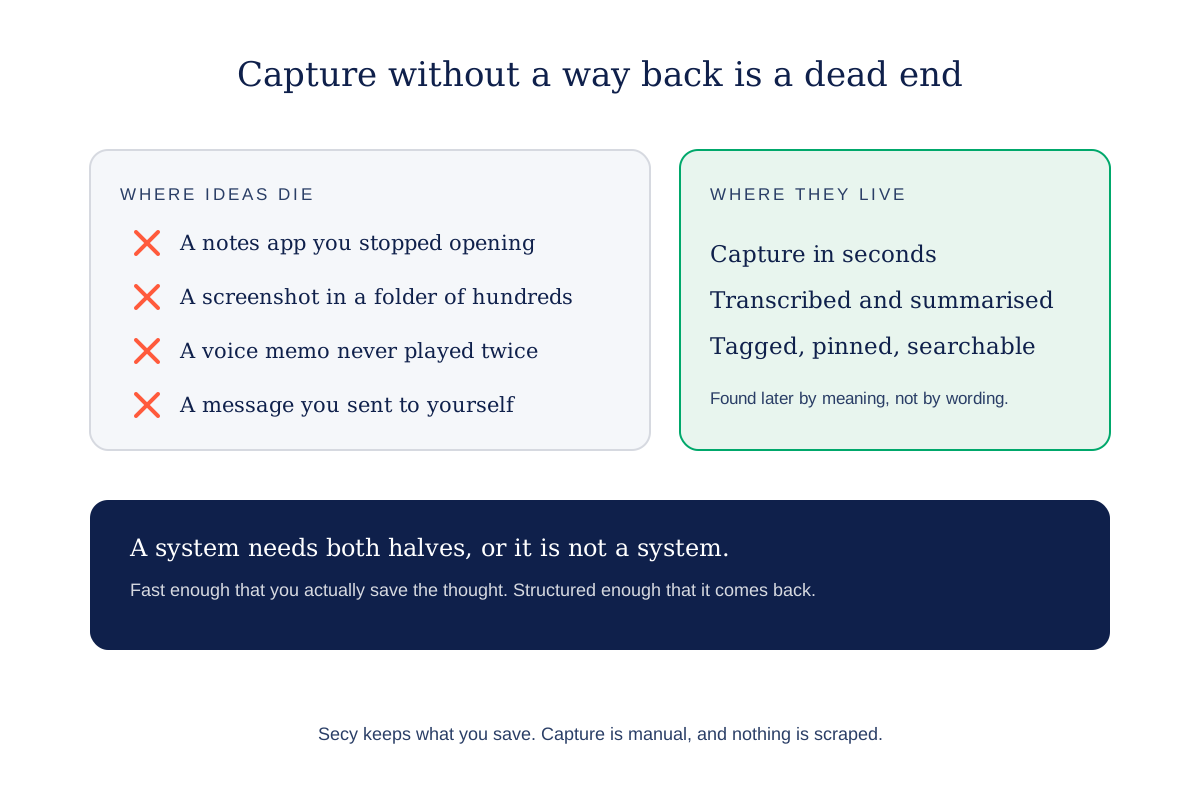
- A notes app you stopped opening. The note exists. You will never see it again.
- A screenshot. Saved in an album with four hundred others, unsearchable.
- A voice memo you never listened to twice. The most reliable place for ideas to die.
- A message to yourself. Buried under everything you sent after it.
- The back of something. A receipt, an envelope, an actual piece of paper.
Each of these captures the idea and then loses it. That is the failure mode: capture without a way back.
Why Capture Fails
Two things break, and they break for different reasons.
Friction kills the first ten seconds. If saving an idea takes more than a few seconds, you will not do it. Not because you are lazy, but because the thought is already fading and you are spending its last moments on a form. The easier path wins, and the easier path is forgetting.
No return path kills the habit. If you never see the thing again, capture starts to feel pointless. You stop, and you are right to stop. A system whose output you never encounter is not a system. It is a graveyard with good intentions.
So a working setup needs both halves. Fast enough to actually use, and structured enough that the idea comes back to you when you go looking.
The Two Halves of Something That Works
Capture has to take seconds. One box, then choose the shape: a link, a note, a voice memo, a photo. No folders to pick, no title to invent, no decisions standing between the thought and the save.
Retrieval has to work by meaning. You will not remember the words you used. You will remember roughly what it was about, months later, on a Tuesday. So search has to find things by topic and by the tags you put on them, not only by the exact phrase.
That is it. Nearly every capture system that fails, fails one of those two.
How This Works in Secy
Secy is built around a vault called Memory, and the design choices follow directly from the two halves above.
Capture takes seconds, and it covers a link, a note, a voice memo, or media. Voice notes are transcribed automatically, so a thought spoken at a traffic light becomes text you can search. Shortly after you save something, Secy adds a short plain-language summary, which means the thing you see later is already legible instead of a raw fragment.
Finding it again works on structure. You can tag items, pin the ones that matter, group related things into smart folders, and search across everything. Over time the vault becomes the only place where your own thinking is actually assembled, rather than scattered across five apps that do not talk to each other.
And one deliberate limit: capture is manual. You decide what is worth keeping. Nothing is scraped from anywhere, and no other app is connected. That is why it stays trustworthy enough to put real thoughts in.
If you want the deeper version of how the vault is organised, read How an AI Secretary Handles Memory. For which kinds of things are worth handing over in the first place, see You Are Not Bad at Delegating.
A Small Test You Can Run This Week
Do not reorganise anything. Just run the loop once.
Next time an idea arrives, save it in under ten seconds, in whatever form is fastest. Do not name it well. Do not file it. Then, three weeks from now, try to find it using only what you remember about the topic.
If you find it, you have a system. If you do not, the problem was never your memory.
Final Thought
An idea you cannot find again is indistinguishable from an idea you never had.
The fix is not remembering harder. It is putting the thought somewhere it can be found by the version of you who has forgotten the words.
Secy keeps what you save, transcribes your voice notes, and lets you find it later by meaning, with capture that takes seconds. 👉 https://secy.io
More in Life Admin

Start with a calmer morning.

From 500+ Beta Testers Reviews