The Future of the Secretary: Will AI Replace Secretaries?
Automation handles the typing. Judgment, discretion, and trust keep the role essential. Here is what the future of the secretary looks like.

Secy
Personal AI Secretary
Our posts are written by the Secy team, with AI assistance and a human review before publishing.
The Question Everyone Asks
Every few years, a new technology prompts the same question about the secretary: is this the end of the role?
It happened with the telephone. It happened with the personal computer. It happened with email. And now it is happening with artificial intelligence, which can draft messages, schedule meetings, summarize documents, and find information in seconds.
The honest answer is more interesting than a simple yes or no. AI will not make secretaries obsolete, but it will change what the best ones do.
What AI Is Already Handling
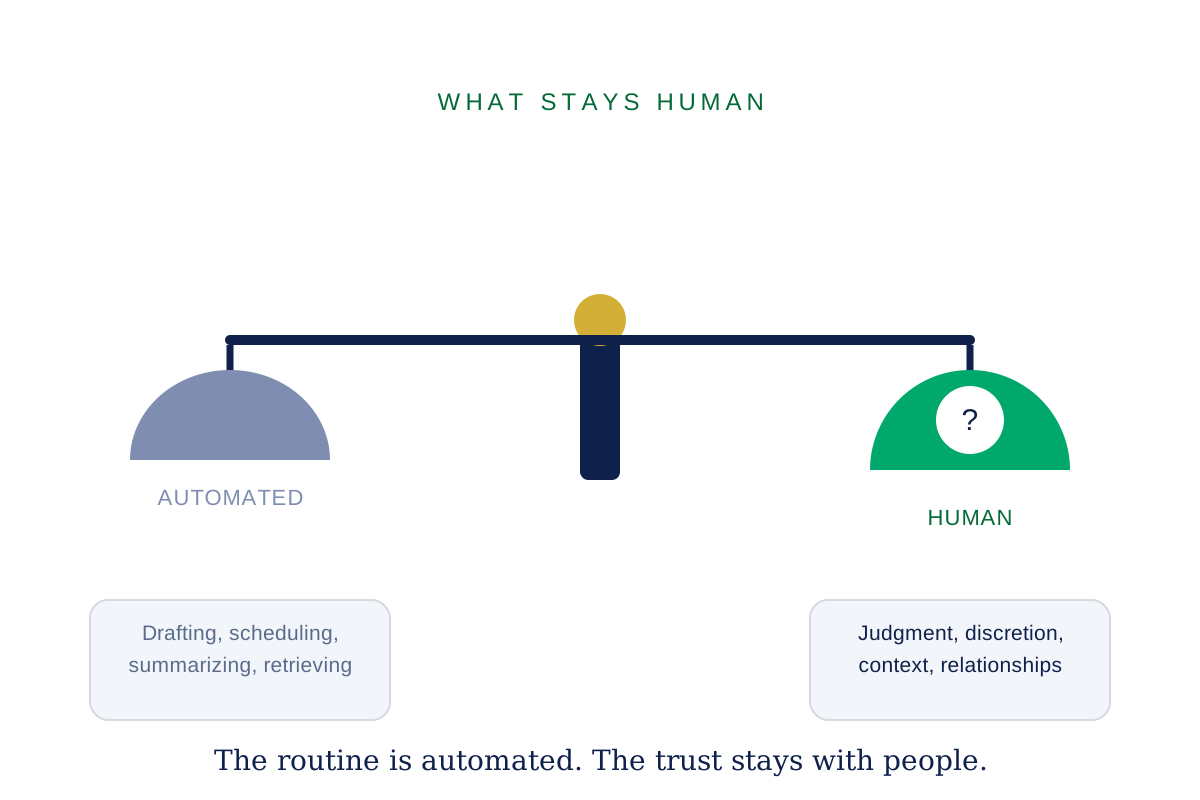
Artificial intelligence is genuinely good at the repetitive, rule-based parts of the job:
- Drafting routine emails and replies.
- Summarizing long documents and meetings.
- Scheduling by checking calendars and finding gaps.
- Transcribing notes and cleaning them up.
- Retrieving files and answering factual questions.
These were exactly the tasks that filled a secretary’s day a generation ago. Software now does them faster and more consistently than any human could.
That is the point. The routine work is leaving the human’s plate, and that is not a threat to the role. It is the same pattern that removed the typing pool.
What Machines Still Do Poorly
The parts of the job that matter most are the parts AI struggles with:
- Judgment. Which meeting should the principal actually attend? Which request deserves a fast reply and which can wait a day?
- Discretion. What is sensitive, who should see it, and what must never be written down?
- Context. Understanding the unspoken history between people, the mood of a room, and what is really being asked.
- Relationships. Representing one person to the world in a way that builds trust, rather than merely exchanging information.
- Accountability. Being the human who owns the outcome when something important goes wrong.
These are not tasks. They are trust. And trust is not something a model can be prompted into.
The Role Is Moving Up, Not Away
History is the best guide. Every wave of automation removed a layer of mechanical work and pushed secretaries toward the work that needed judgment.
A century ago, the role was about records and letters. As those became routine, the role moved toward scheduling and communication. As those became digital, it moved toward prioritization and orchestration. Now, as AI absorbs scheduling and drafting, the role is moving toward something closer to a trusted advisor and operator:
- Setting priorities rather than just filling time.
- Making sure the right information reaches the right person.
- Overseeing the AI tools that do the routine work.
- Protecting the principal’s attention, which is now the scarcest resource of all.
In other words, the secretary keeps climbing the same ladder the executive assistant climbed before it: from typing, to coordinating, to thinking.
What This Means for Secretaries Today
For people in the role, the practical takeaway is encouraging:
- Routine skills matter less than they used to. Anyone can draft an email with AI.
- Judgment and trust matter more than ever. These are the moat that software cannot cross.
- Comfort with tools is now table stakes. The secretary who directs AI, rather than competing with it, has the advantage.
- The title may change, but the function endures. As the work moves up, roles get renamed, from secretary to assistant to operator.
The secretary who treats AI as a junior colleague to direct, rather than a rival to fear, will always have a job. The question is not whether the role survives. It is how far up it will go.
What This Means for the Rest of Us
For everyone who does not have a secretary, the same forces matter. The routine logistics of modern life, scheduling, remembering, drafting, following up, are increasingly things software can handle.
That raises a quieter possibility: in the future, the “secretary” many people rely on will not be a person in the next office. It will be a personal assistant, part human judgment and part software, that manages the flow around you.
Whatever form it takes, the underlying promise is the same one this series started with: someone, or something, keeps your world in order so you can focus. New here? Start with What Is Secy?
Sources & Further Reading
- U.S. Bureau of Labor Statistics: the occupation’s definition and long-term outlook (bls.gov/ooh/office-and-administrative-support/secretaries-and-administrative-assistants.htm)
- World Economic Forum: how automation and AI are reshaping jobs (weforum.org/publications/the-future-of-jobs-report-2025/)
- Merriam-Webster: the definition of secretary (merriam-webster.com/dictionary/secretary)
- Oxford Learner’s Dictionaries: the modern meaning of secretary (oxfordlearnersdictionaries.com/definition/english/secretary)
Part of the What Is Secy series. New here? Start with What Is Secy? · Next up: History of the Word “Secretary”
AI will take the typing. It will not take the trust. The role keeps moving up. 👉 Read: What Is Secy?
More in Secretary
Start with a calmer morning.

From 500+ Beta Testers Reviews